Project Phi Grid — Independent Research
A rigorous statistical investigation into whether φ-ratio geometry structures the Earth, the solar system, and the stellar neighbourhood.
An interactive 3D explorer built on the research data. Zoom from Earth's geomagnetic grid — Wilkes Land, Hiawatha, INTERMAGNET stations — out through the solar system, Kuiper Belt, heliosphere, inner and outer Oort Cloud, to the stellar neighbourhood at 20 light-years. Φ-ratio shells visible at every scale.
Project Phi Grid tests a precise, falsifiable hypothesis: that the golden ratio φ structures the geometry of natural systems at multiple scales — from Earth's surface to the stellar neighbourhood — at levels of statistical significance that cannot be explained by chance.
The golden ratio φ appears throughout nature — in nautilus shells, sunflower seeds, and galaxy spirals. Phi Grid asks whether this isn't coincidence: whether φ actually governs how structures are spaced at cosmic scales.
We test this with real data, pre-registered hypotheses, and rigorous statistics. If φ-shells anchored at Neptune predict where nearby stars cluster — and no other anchor does — that demands explanation.
The core test: KDE of radial stellar distances (volume-corrected, bandwidth 0.8 ly) against φ-ratio geometric progressions rₙ = r₀ × φⁿ. Monte Carlo null distributions constructed from N=100,000 random geometric progressions and random position sets.
Anchor specificity: 11 candidate anchors tested. Only Neptune (30.069 AU) and Kuiper Belt outer edge (~50 AU) return p<0.05. Inner solar system bodies, heliopause, and Oort Cloud all return p>0.75. Pre-registration: OSF osf.io/a72fp.
Each result is accompanied by its p-value, dataset, and pre-registration record. Null results are reported alongside positive ones.
The Gaia null result is reported prominently and without spin. Pre-registered science means the hypothesis is tested honestly — a null result is a result. The partial 0–20 ly concordance is currently under investigation as a focused replication study.
The most important control in this research: the same test was run identically on 11 candidate anchors spanning the solar system. Inner planets, the Sun, the heliopause, and the Oort Cloud all return null. Only the outer Neptune/Kuiper boundary is significant — both physically meaningful anchors that mark the edge of Neptune's dynamical zone.
| Anchor | Distance (AU) | p-value | Significant? |
|---|---|---|---|
| Mercury | 0.387 | > 0.75 | No |
| Venus | 0.723 | > 0.75 | No |
| Earth | 1.000 | > 0.75 | No |
| Mars | 1.524 | > 0.75 | No |
| Jupiter | 5.203 | > 0.75 | No |
| Saturn | 9.537 | > 0.75 | No |
| Uranus | 19.191 | > 0.75 | No |
| Neptune | 30.069 | 0.0285 | Yes ★ |
| Kuiper Belt outer edge | ~50 | 0.0285 | Yes ★ |
| Heliopause | ~120 | > 0.75 | No |
| Oort Cloud (inner) | ~2,000 | > 0.75 | No |
★ Both significant anchors mark the outer boundary of Neptune's dynamical zone. Citation: Volk et al. 2019, AJ 158 64. DOI: 10.3847/1538-3881/ab2c3b
All papers, notebooks, and pre-registrations are publicly available. Reproducibility is a core commitment of this project.
Three independent Monte Carlo analyses test whether the dual-anchor φ-grid — anchored at the Wilkes Land crustal gravity anomaly and the Hiawatha impact crater — shows statistically significant spatial association with globally distributed ancient monuments.
The same 16-petal φ-ratio grid used in the Earth paper is applied to ancient monument databases. The grid was not adjusted or optimised for archaeological data — it is applied unchanged from the geophysical analysis.
The most striking single observation is the triple angular/radial alignment of Göbekli Tepe — the world's oldest known monumental structure (~9600 BCE) — against both anchors simultaneously. Angular error from Wilkes: 0.18°. Radial error: 1.91%. Angular error from Hiawatha: 0.97°. All three values are within the pre-specified thresholds.
Göbekli Tepe falls 264 km from the nearest grid node — just outside the 200 km proximity threshold — and is classified HIGH INTEREST. Karahan Tepe (~9400 BCE), 46 km from Göbekli Tepe, falls at 290 km from the same node. The two oldest sites in the dataset cluster at the same node.
Göbekli Tepe (37.22°N, 38.92°E; southeastern Turkey) is the world's oldest known monumental structure, with radiocarbon-dated enclosures at ~9600–8800 BCE — predating the Egyptian pyramids by 7,000 years. Less than 10% of the site has been excavated; ground-penetrating radar indicates at least 20 buried circular enclosures remain.
Giza (Great Pyramid complex, ~2560 BCE) sits on the same Wilkes Petal 13 bearing as Göbekli Tepe at a different radial shell — a co-petal relationship between the world's oldest and most famous monument complexes separated by 7,000 years of history. No causal mechanism is proposed; this is reported as a geometric observation.
Sites confirmed within the 200 km proximity threshold in Analysis I (UNESCO) and/or appearing as HIGH INTEREST near-misses across analyses. All photographs are public domain or Creative Commons licensed.
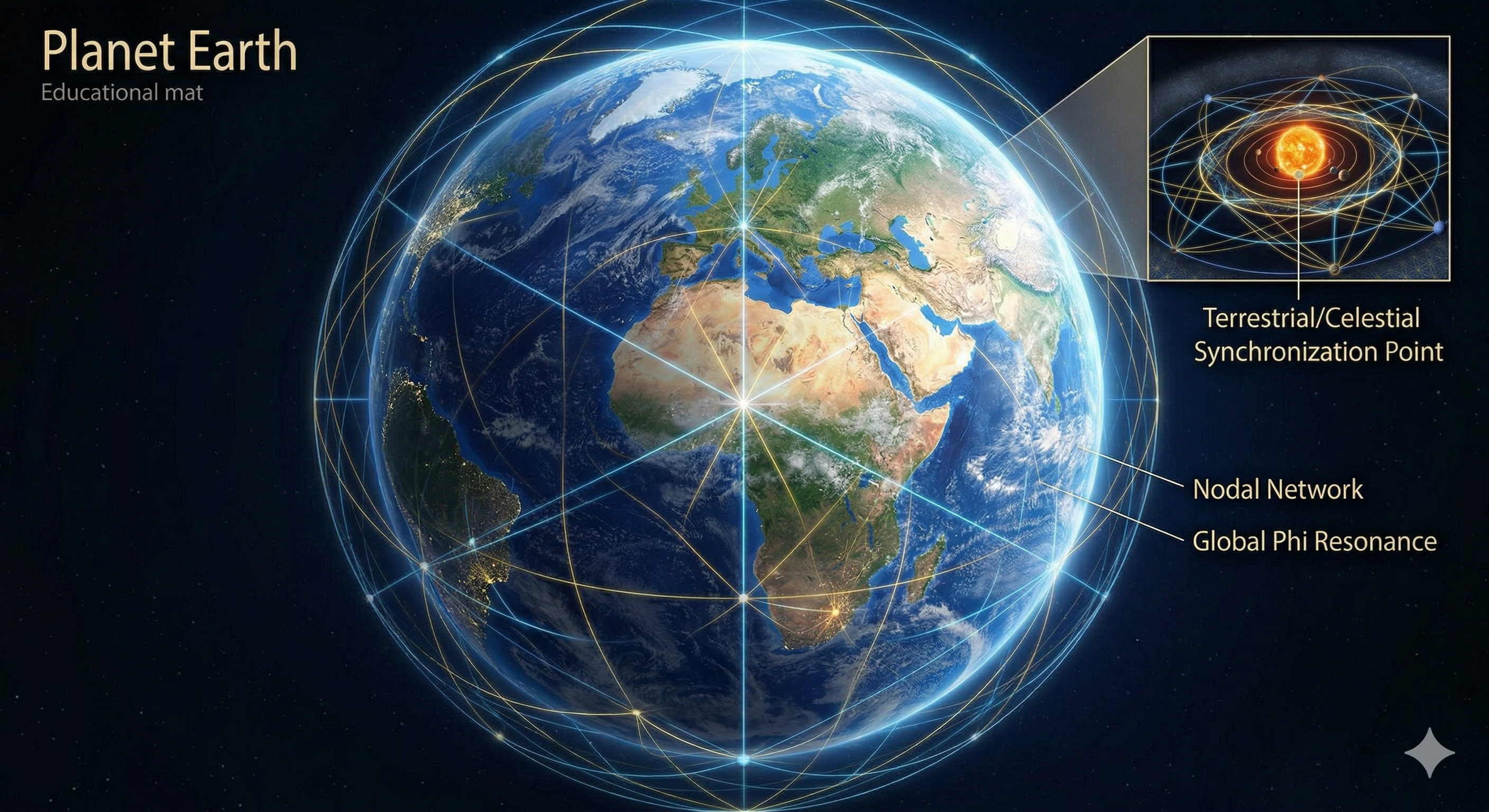
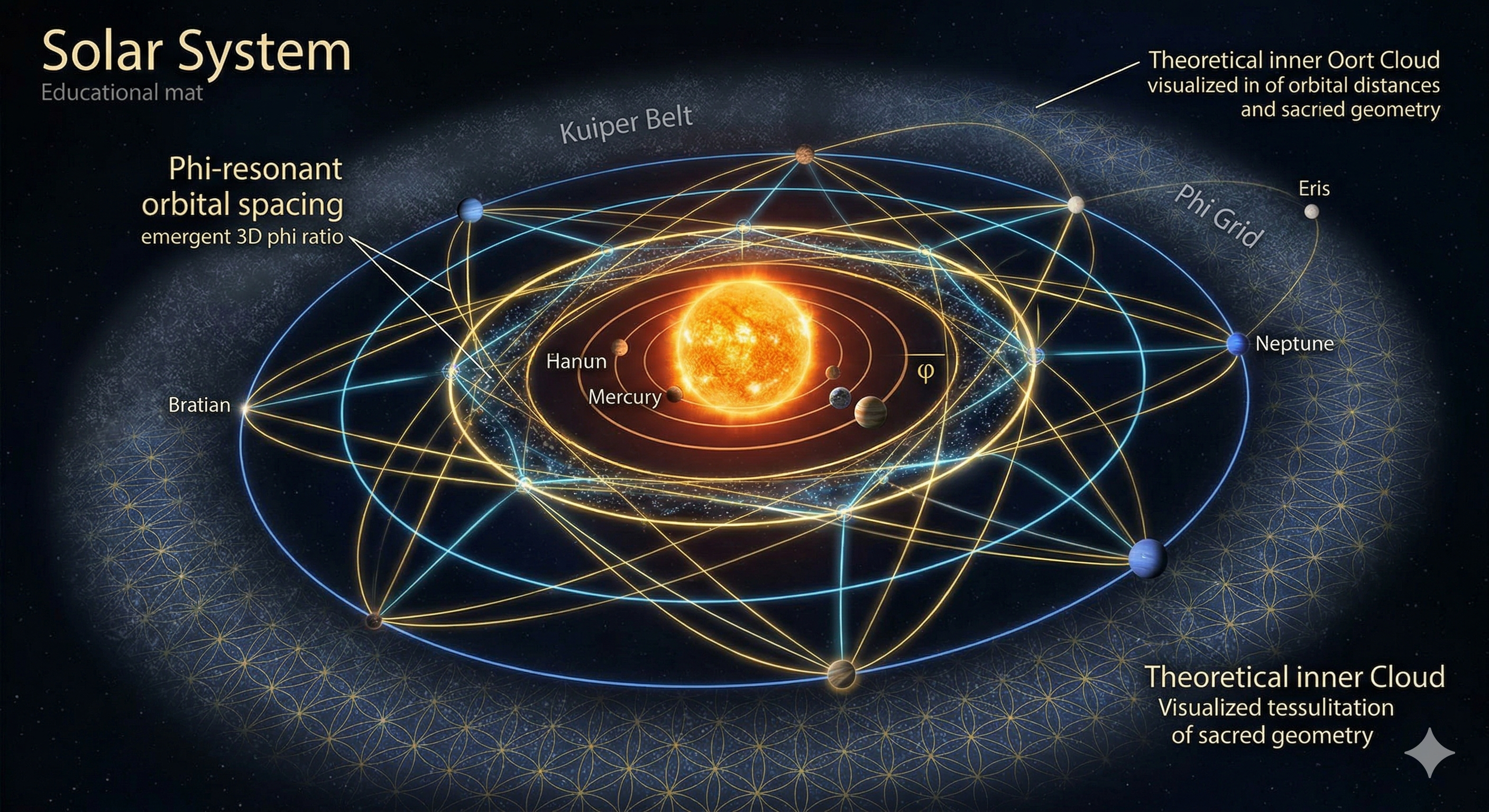
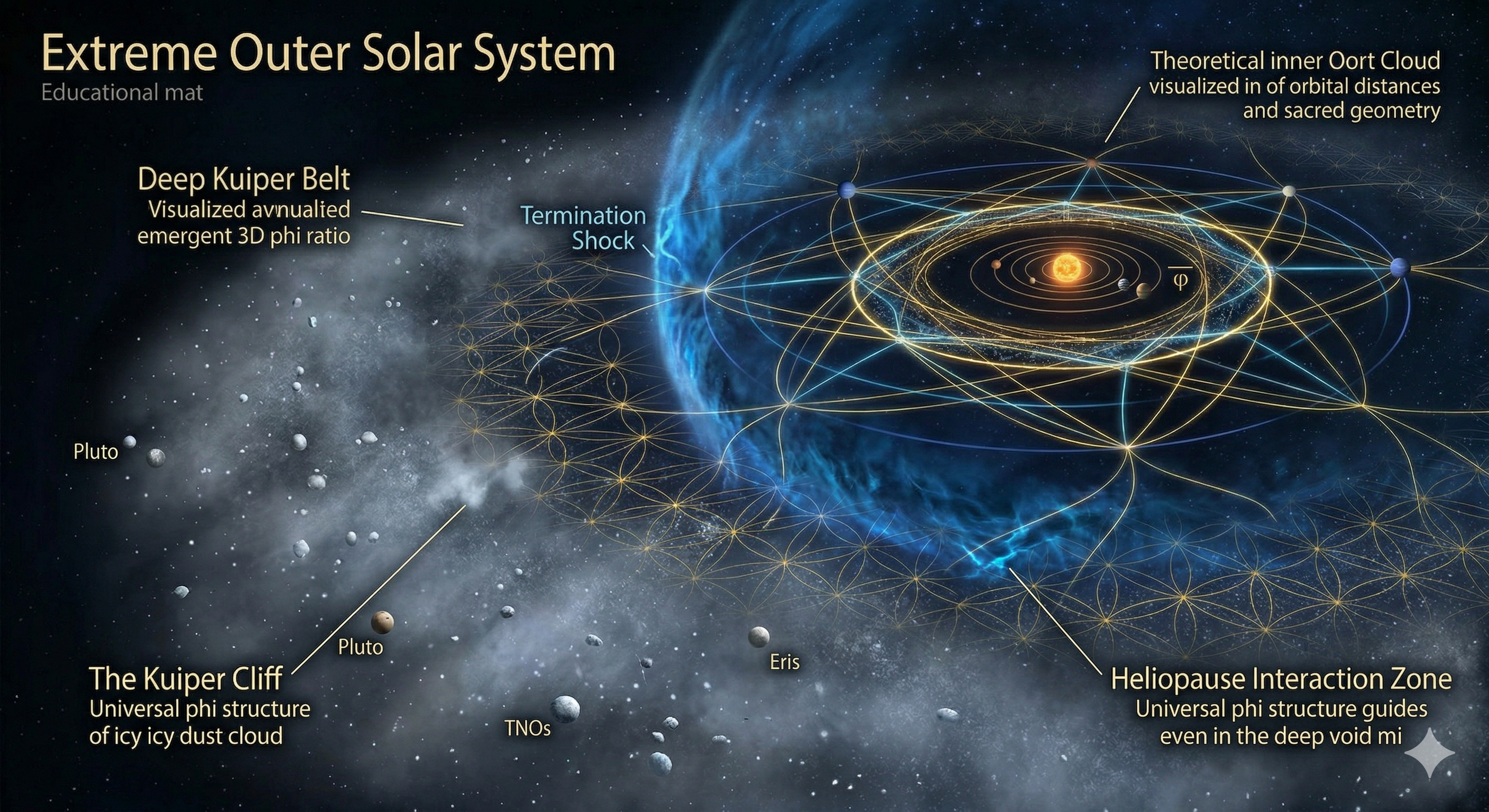
Conceptual illustrations showing the φ-ratio structure at three scales: Earth's surface, the solar system, and the extreme outer solar system boundary where the signal is detected.
Whether you're a researcher interested in collaboration, a journalist covering independent science, or a member of the public with questions — reach out.